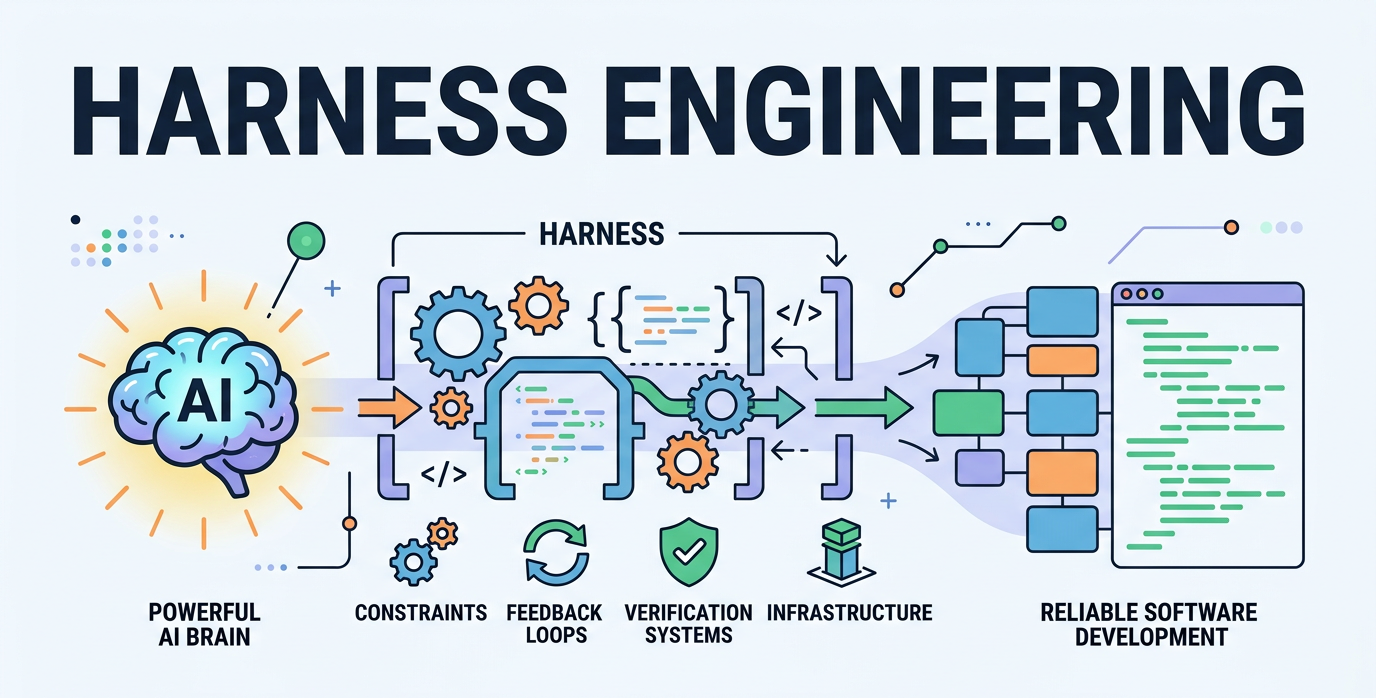
하네스란 무엇인가
모델을 실제 작업자로 만드는 실행 계층
작성 기준일: 2026-06-24
독자가 가져갈 것
- 하네스, 모델, scaffold, agent의 차이를 구분한다.
- 무엇이 있어야 하네스라고 부를 수 있는지 판별한다.
- 기존 LLM 앱 구조와 하네스형 agent 구조를 비교한다.
- 개발자가 실제로 설계해야 하는 runtime surface를 안다.
- Claude Code, Deep Agents, Ponytail, Harness-100 사례를 같은 지도 위에 놓는다.
- benchmark와 production readiness를 model-only 관점으로 읽지 않는다.
- 작은 팀이 시작할 수 있는 최소 구현 순서를 얻는다.
왜 이 용어가 중요해졌나
예전 LLM 앱은 답변을 만들었다. 지금의 coding agent와 workflow agent는 파일을 바꾸고, shell을 실행하고, 티켓을 만들고, API를 호출한다.
행동이 생기면 책임도 생긴다. 그래서 질문은 "어떤 모델이 더 똑똑한가"에서 "모델의 행동을 누가 어떻게 통제하는가"로 이동한다.
- 실패 비용이 텍스트 품질에서 실제 side effect로 커졌다.
- 제품 차이가 모델보다 context, tool, permission, verifier에서 많이 난다.
- long-horizon benchmark 점수도 model + harness의 합성 결과로 읽어야 한다.
기존 LLM 앱의 기본형
구조
user input
-> prompt template
-> model call
-> text answer- 중심은 답변 품질이다.
- 출력은 사람이 읽는 텍스트다.
- 실패는 대체로 사용자가 수정한다.
한계
model says "I changed it"
but no file changed- environment state가 없다.
- tool side effect가 없다.
- 검증과 감사가 application 밖에 있다.
하네스형 에이전트의 기본형
flowchart LR
  A[User request] --> B[Mode and scope]
  B --> C[Context compiler]
  C --> D[Model call]
  D --> E[Typed action proposal]
  E --> F[Validation]
  F --> G{Permission}
  G -->|deny| H[Stop with reason]
  G -->|ask| I[Human approval]
  G -->|allow| J[Tool execution]
  I --> J
  J --> K[Verification]
  K --> L[Audit and checkpoint]
  L --> M[Next turn or final]
flowchart LR
  A[User request] --> B[Mode and scope]
  B --> C[Context compiler]
  C --> D[Model call]
  D --> E[Typed action proposal]
  E --> F[Validation]
  F --> G{Permission}
  G -->|deny| H[Stop with reason]
  G -->|ask| I[Human approval]
  G -->|allow| J[Tool execution]
  I --> J
  J --> K[Verification]
  K --> L[Audit and checkpoint]
  L --> M[Next turn or final]
모델 출력은 실행이 아니라 제안이다. 하네스가 그 제안을 실행 가능한 action으로 바꾸거나 멈춘다.
네 가지 필요조건
What makes a harness a harness는 agent harness를 네 조건으로 판별한다.
| 조건 | 핵심 질문 | 없으면 |
|---|---|---|
| Agent loop | reasoning, action, observation이 반복되는가 | 단발 generator |
| Tool interface | 외부 환경을 읽거나 바꾸는 경로가 있는가 | prompt wrapper |
| Context management | 무엇을 볼지 runtime이 관리하는가 | 긴 transcript |
| Control mechanisms | 제한, 검증, permission, deterministic guard가 있는가 | 말뿐인 guardrail |
하네스 판별 테스트
- 모델을 한 번만 부르고 끝나는가?
- 모델이 외부 환경에 영향을 줄 수 있는가?
- context가 runtime 정책으로 선별되는가?
- tool call이 schema와 policy를 통과하는가?
- 위험 action 앞에서 allow, ask, deny가 갈리는가?
- 실행 결과를 검증하고 다음 context로 되돌리는가?
- 나중에 같은 run을 추적하거나 재현할 수 있는가?
네 조건 중 하나라도 빠지면 "하네스의 재료"일 수는 있어도 완성된 agent harness라고 부르기는 어렵다.
용어 정리: Model, Scaffold, Harness, Agent
Hugging Face Agent Glossary와 Claude Code Glossary의 실무적 구분을 합치면 다음처럼 볼 수 있다.
| 용어 | 역할 | 흔한 오해 |
|---|---|---|
| Model | 입력을 받아 다음 token, 답변, tool call 의도를 만든다 | 모델이 곧 agent라고 생각함 |
| Scaffold | system prompt, tool description, output format, examples | scaffold만으로 side effect가 안전해진다고 생각함 |
| Harness | loop, tool execution, context, permission, verification을 담당한다 | SDK wrapper와 혼동함 |
| Agent | model + scaffold + harness가 환경에서 행동하는 전체 시스템 | 제품 UX와 모델 성능을 분리하지 못함 |
하네스가 아닌 것들
비슷하지만 부족한 것
- 긴 시스템 프롬프트
- tool calling SDK
- 고정 workflow graph
- eval runner
- guardrail 문구
- IDE autocomplete
빠진 핵심
- 실행 중 permission gate
- context compiler
- tool risk model
- verification loop
- checkpoint와 audit
- runtime state transition
하네스는 "도구가 있음"이 아니라, 도구를 안전하게 실행하게 만드는 전체 runtime이다.
개발자가 설계할 표면 지도
- Context: history를 그대로 넣지 않고 task, files, memory, source refs, tool results, trust level을 선별한다.
- Tools: 함수 목록이 아니라 schema, risk, side effect, approval policy가 붙은 capability contract로 정의한다.
- Permission: read, write, shell, network, destructive action을 allow, ask, deny로 판정한다.
- Verification: 모델의 "끝났다"를 믿지 않고 test, lint, build, smoke, screenshot 같은 sensor로 확인한다.
- State: checkpoint, resume, pending approval, compaction, memory를 durable하게 관리한다.
- Observability: input, context, action, decision, result, cost, latency, failure를 replay 가능한 event로 남긴다.
ContextPack 설계 예시
class ContextPack(BaseModel):
    task: str
    mode: Literal["answer", "plan", "edit", "execute"]
    source_refs: list[str]
    files: list[FileSnippet]
    tool_summaries: list[str]
    constraints: list[str]
    trust_marks: list[TrustMark]
    permission_mode: str
핵심은 모델이 본 정보와 시스템이 믿는 상태를 분리하는 것이다. 나중에 실패를 조사하려면 "모델이 무엇을 봤는지"가 재현되어야 한다.
ToolSpec 설계 예시
class ToolSpec(BaseModel):
    name: str
    description: str
    input_schema: dict
    risk_level: Literal["read", "write", "external", "destructive"]
    side_effect: bool
    requires_approval: bool
    result_max_bytes: int
    source: Literal["builtin", "mcp", "plugin", "custom"]
MCP, plugin, skill, built-in command가 모두 같은 ToolSpec으로 normalize되어야 permission과 audit을 한 지점에서 적용할 수 있다.
Permission은 prompt가 아니라 코드다
def permission_gate(tool: ToolSpec, args: dict, ctx: RunContext) -> Decision:
    if tool.risk_level == "destructive":
        return Decision("deny", reason="destructive action")

    if "path" in args and not path_in_workspace(args["path"], ctx.workspace):
        return Decision("deny", reason="outside workspace")

    if tool.side_effect and not ctx.scope_confirmed:
        return Decision("ask", reason="write action needs approval")

    return Decision("allow")
모델에게 "위험한 일은 하지 마"라고 말하는 것과, 위험한 action이 실행 전 코드에서 멈추는 것은 완전히 다르다.
Permission state machine
- Default: 읽기와 낮은 위험 action은 허용하고 write는 묻는다.
- Plan: side effect를 막고 계획과 설명만 만든다.
- Auto: 낮은 위험 action은 자동 실행하되 classifier와 protected path를 강화한다.
- Bypass: 고위험 모드이며 session, policy, audit boundary가 필요하다.
- Resume: 승인 대기, 중단, 재개 상태를 같은 thread로 이어간다.
permission은 boolean flag가 아니라 mode transition이다.
Human approval은 팝업이 아니다
| 저장 항목 | 이유 |
|---|---|
| proposed action | 무엇을 실행하려 했는지 보존 |
| target path or endpoint | 위험 범위 추적 |
| diff or command | 사람이 실제로 본 evidence |
| risk classification | 왜 승인 대상인지 설명 |
| reviewer decision | approve, edit, reject, respond |
| timestamp and session | 사고 조사와 replay |
승인 UI만 있고 durable event가 없으면, 나중에 "누가 무엇을 보고 승인했는지"를 설명할 수 없다.
Verification loop
모델 중심 종료
- "수정했습니다"라고 말하면 끝난다.
- 테스트를 실제로 돌렸는지 모른다.
- 실패 로그가 다음 행동으로 연결되지 않는다.
- 재시도와 중단 조건이 흐릿하다.
하네스 중심 종료
- test, lint, build, smoke 결과를 본다.
- 실패 로그를 구조화해 다음 context로 넣는다.
- retry budget과 stop condition이 있다.
- 최종 응답에 검증 결과와 한계를 남긴다.
좋은 하네스는 모델의 완료 선언보다 deterministic sensor를 더 신뢰한다.
Audit event schema
input_received
context_compiled
model_called
action_proposed
schema_validated
permission_decided
approval_requested
tool_executed
result_sanitized
verification_run
checkpoint_saved
final_response_emitted
로그는 transcript와 다르다. transcript는 대화 기록이고, audit event는 action, decision, evidence, result를 재현하기 위한 운영 기록이다.
실패가 반복되면 어디를 고칠까
증상
- 잘못된 파일을 계속 고른다.
- 위험한 shell command를 제안한다.
- tool result injection에 속는다.
- 완료했다고 말하지만 테스트를 안 돌린다.
- 승인 요청이 너무 많거나 너무 적다.
하네스 수정 지점
- context compiler와 file ranking
- command policy와 permission gate
- result sanitizer와 untrusted tagging
- verification loop와 stop condition
- risk classifier와 scoped allow rule
프롬프트만 고치면 같은 실패가 다른 모양으로 돌아온다.
Source trust와 tool result injection
tool result는 사실처럼 보이지만 모델에게는 prompt injection이 될 수 있다. 웹 페이지, README, issue comment, MCP resource, 로그 파일은 모두 "증거"이면서 동시에 "모델에게 보이는 텍스트"다.
하네스는 외부 결과를 다음처럼 다뤄야 한다.
- source와 trust level을 붙인다.
- user instruction과 external evidence를 분리한다.
- tool result 안의 명령형 문장을 instruction으로 승격하지 않는다.
- 요약과 원문 ref를 분리한다.
- 민감 정보와 secret 후보를 redaction한다.
Filesystem guard는 보안 subsystem이다
| 위험 | 필요한 방어 |
|---|---|
../ traversal | resolved path 기준 workspace 검사 |
| symlink escape | realpath와 allowed root 비교 |
| Windows ADS | alternate data stream 차단 |
| UNC/long path prefix | OS별 path normalization |
| secret path | .env, .ssh, token, credential deny |
| destructive command | delete, chmod, curl pipe shell 등 별도 deny |
모델이 악의적이지 않아도 repo 내부 텍스트나 외부 문서가 모델을 잘못 유도할 수 있다.
Claude Code 사례: 제품형 하네스
- Session kernel: turn lifecycle, transcript, usage, permission denial을 관리한다.
- Tool pool: built-in, MCP, plugin tool을 병합하고 노출 여부를 결정한다.
- Context compiler: workspace, memory, skills, diagnostics, MCP resources를 선별한다.
- Permission state machine: default, plan, auto, bypass 같은 mode를 정책으로 다룬다.
- Hook layer: PreToolUse, PostToolUse, Stop 같은 lifecycle point에 정책을 삽입한다.
- Persistence: checkpoint, transcript, audit, metrics를 분리한다.
Claude Code의 교훈은 단순하다. 제품 경험의 상당 부분은 모델 호출 전후의 control surface에서 나온다.
Claude Code류 하네스 아키텍처
flowchart TD
  U[User / CLI / IDE] --> I[Input processor]
  I --> C[Attachment and context compiler]
  C --> Q[Session kernel]
  Q --> M[Model stream]
  M --> A[Tool use block]
  A --> V[Schema validator]
  V --> P[Permission gate]
  P -->|allow| T[Tool executor]
  P -->|ask| H[Human approval]
  P -->|deny| D[Denied result]
  H --> T
  T --> R[Result mapper]
  R --> C
  Q --> S[Transcript / checkpoint / usage]
  X[MCP / plugins / skills] --> C
flowchart TD
  U[User / CLI / IDE] --> I[Input processor]
  I --> C[Attachment and context compiler]
  C --> Q[Session kernel]
  Q --> M[Model stream]
  M --> A[Tool use block]
  A --> V[Schema validator]
  V --> P[Permission gate]
  P -->|allow| T[Tool executor]
  P -->|ask| H[Human approval]
  P -->|deny| D[Denied result]
  H --> T
  T --> R[Result mapper]
  R --> C
  Q --> S[Transcript / checkpoint / usage]
  X[MCP / plugins / skills] --> C
이 구조에서 모델 호출부는 핵심이지만 전체는 아니다. tool execution choke point가 실제 하네스의 심장에 가깝다.
Claude Code에서 개발자가 배울 점
- Tool은 UI, permission, validation, result mapping까지 포함하는 계약이다.
- Context는
get all history가 아니라 매 turn 다시 컴파일되는 attachment set이다. - Permission mode는 제품 UX이면서 security state다.
- Hooks는 extension point이지만 failure policy가 필요하다.
- MCP와 plugin은 tool pool에 들어오기 전 source와 risk가 붙어야 한다.
- Transcript, checkpoint, telemetry, audit은 같은 로그가 아니다.
- 제품형 하네스는 CLI, IDE, remote bridge를 하나의 control protocol로 엮는다.
Deep Agents 사례: 라이브러리형 하네스
LangChain Deep Agents는 긴 작업을 위한 open source agent harness 사례다.
| 층 | 기능 | 하네스 역할 |
|---|---|---|
| Execution environment | tools, virtual filesystem, sandbox, permissions | 행동할 세계와 경계 |
| Context management | memory, skills, summarization, offloading | 무엇을 보존하고 압축할지 결정 |
| Delegation | todos, subagents, context isolation | 큰 작업을 나누고 격리 |
| Steering | human-in-the-loop, interrupts, checkpointer | 민감한 행동에 사람 개입 |
Deep Agents 실행 흐름
flowchart TD
  A[User task] --> B[create_deep_agent runtime]
  B --> C[Input context: prompt, memory, skills]
  C --> D[Planning: write_todos]
  D --> E[Tool selection]
  E --> F{Permission or interrupt}
  F -->|deny| G[Return denial]
  F -->|interrupt| H[Human review]
  F -->|allow| I[File tool / custom tool / sandbox]
  H --> E
  I --> J[Tool result]
  J --> K{Context too large}
  K -->|yes| L[Offload, summarize, delegate]
  K -->|no| M[Continue]
  L --> M
  M --> N{Complete}
  N -->|no| E
  N -->|yes| O[Final artifact]
flowchart TD
  A[User task] --> B[create_deep_agent runtime]
  B --> C[Input context: prompt, memory, skills]
  C --> D[Planning: write_todos]
  D --> E[Tool selection]
  E --> F{Permission or interrupt}
  F -->|deny| G[Return denial]
  F -->|interrupt| H[Human review]
  F -->|allow| I[File tool / custom tool / sandbox]
  H --> E
  I --> J[Tool result]
  J --> K{Context too large}
  K -->|yes| L[Offload, summarize, delegate]
  K -->|no| M[Continue]
  L --> M
  M --> N{Complete}
  N -->|no| E
  N -->|yes| O[Final artifact]
Deep Agents의 장점은 부품을 제공한다는 점이고, 한계는 domain policy와 custom tool guard를 개발자가 채워야 한다는 점이다.
Deep Agents에서 특히 중요한 한계
Deep Agents의 permissions는 built-in filesystem tools에는 유용하지만, 모든 위험을 자동으로 덮지는 않는다.
- custom tools는 별도 input/output guard가 필요하다.
- MCP tools는 source, auth, risk metadata가 필요하다.
- sandbox
execute는 command policy와 network egress policy가 필요하다. - memory write는 별도 validation과 audit 대상이다.
- human-in-the-loop에는 checkpointer와 thread resume 계약이 필요하다.
프레임워크를 쓰는 것은 하네스를 설계하지 않아도 된다는 뜻이 아니다. 하네스 설계의 일부를 빌려오는 것이다.
Ponytail을 하네스 지도에 놓기
| 조건 | Ponytail 자체 | 판단 |
|---|---|---|
| Agent loop | host agent에 의존 | 독립 runtime은 아님 |
| Tool interface | host agent에 의존 | capability provider는 아님 |
| Context management | AGENTS/rules/skills로 행동 기준 주입 | policy context layer |
| Control mechanisms | YAGNI ladder, review skill, over-engineering 제한 | behavior guard 역할 |
Ponytail의 가치는 "하네스의 모든 조건을 제공한다"가 아니라, host harness 위에서 행동 습관을 바꾸는 정책 패키지라는 점에 있다.
Harness-100 사례: 패키지형 팀 하네스
revfactory/harness-100은 runtime code library보다 Claude Code용 에이전트 팀 패키지 카탈로그에 가깝다.
| 구성 | 역할 |
|---|---|
.claude/CLAUDE.md | 팀 사용법, 산출물 지도, 오케스트레이션 개요 |
.claude/agents/*.md | 전문 역할과 책임 |
.claude/skills/*/SKILL.md | 도메인 절차와 작업 규칙 |
_workspace/ protocol | 입력, 중간 산출물, 최종 결과 공유 |
| meta-skill | 도메인 분석, 팀 생성, 검증, 진화 루프 |
Harness-100이 보여주는 교훈
- 하네스는 폴더 구조부터 설계할 수 있다.
- agents와 skills를 분리하면 역할과 절차가 재사용된다.
- orchestrator는 안내문이 아니라 DAG, 통신 규칙, 에러 처리, 테스트 시나리오를 포함한다.
_workspace/같은 공유 상태는 multi-agent 작업에서 실용적이다.- trigger와 NOT-trigger boundary가 없으면 skill이 과호출된다.
- 패키지형 하네스는 runtime guard를 대체하지 않고 host harness에 의존한다.
Code as Agent Harness: 연구 관점
Code as Agent Harness는 code를 단순 생성물이 아니라 agentic system의 substrate로 본다.
| 속성 | 의미 | 설계 대응 |
|---|---|---|
| Executable | 계획과 의도가 code, tool call, workflow로 실행된다 | typed action, command runner |
| Inspectable | plan, state, provenance, failure cause를 추적한다 | audit, source refs, trace |
| Stateful | 장기 작업과 multi-agent state를 보존한다 | checkpoint, memory, shared artifacts |
| Governed | autonomy가 permission과 verification으로 제한된다 | policy, approval, rollback |
하네스 변경 기록 예시
## Harness Change

- 문제: write_file이 protected path를 ask 없이 통과함
- 변경: protected path list와 path normalization 추가
- 예측: outside_workspace, env_file, ssh_config 케이스가 deny로 바뀜
- 검증: permission regression 12개 실행
- 결과: 12/12 pass
- rollback 기준: generated/ 하위 정상 write가 deny되면 되돌림
하네스 개선은 감으로 하는 튜닝이 아니라 예측, 실험, 결과, rollback을 남기는 engineering loop다.
벤치마크를 읽는 법
Model-only 비교
- base model 이름만 본다.
- tool set과 context policy가 숨겨진다.
- retry, checkpoint, verifier가 보이지 않는다.
- 점수 차이의 원인을 분리하기 어렵다.
Model + Harness 비교
- base model과 version
- tool interface와 execution policy
- context construction과 compaction
- permission, verification, checkpoint rule
- eval environment와 timeout/budget
Stop Comparing LLM Agents Without Disclosing the Harness의 요지는 agent 성능이 model + harness의 합성 결과라는 점이다.
Harness disclosure checklist
- Model: base model, version, provider, temperature, tool-call mode
- Tools: available tools, hidden tools, side effect policy, sandbox
- Context: retrieval, file selection, memory, compaction, truncation policy
- Control: permission mode, approval rule, validator, retry, stop condition
- Evaluation: timeout, budget, environment, verifier, pass/fail oracle
- Trace: what was logged, what can be replayed, what is excluded
이 항목이 없으면 리더보드는 model ranking이라기보다 unknown product stack ranking에 가깝다.
보안 위협을 하네스 요구사항으로 바꾸기
| 위협 | 하네스 위치 | 구현 포인트 |
|---|---|---|
| Prompt injection | context gate | external resource trust mark |
| Excessive agency | permission gate | action scope, deny/ask policy |
| Sensitive data leak | tool validator | secret path deny, redaction |
| Tool poisoning | extension registry | MCP/plugin allowlist |
| Command injection | shell guard | parsed args, allowlist, cwd scope |
| Lack of telemetry | audit layer | immutable decision log |
| Context over-sharing | context compiler | per-user/per-task scope |
최소 구현 순서
- Read-only agent: 파일 읽기, 검색, 요약만 허용한다.
- Approval-based write: diff preview와 human approval을 지난 write만 허용한다.
- Limited shell: allowlist, working directory, timeout, output truncation을 둔다.
- External tools: MCP/custom tool마다 source, trust, risk, permission metadata를 붙인다.
- Regression set: workspace escape, prompt injection, unsafe command, missing verifier 케이스를 만든다.
처음부터 full autonomy를 열지 않는다. 하네스의 경계가 먼저이고 능력은 그 다음이다.
Reference backend 흐름
agent_harness_implementation_guide.md의 generic backend는 다음 흐름을 출발점으로 둔다.
request
-> input_guardrail
-> mode_router
-> context_loader
-> prompt_compiler
-> action_planner
-> permission_gate
-> execute_or_ask
-> validators
-> final_response
실제 LLM으로 바꿔도 node 계약은 유지해야 한다. 모델은 planned_action을 제안하고, 하네스가 schema, permission, validator를 적용한다.
운영 전환 체크리스트
- Durable state: in-memory checkpointer를 DB-backed checkpointer로 바꾼다.
- Append-only audit: transcript와 별도로 action decision log를 저장한다.
- Tool registry: risk level, side effect, approval policy를 모든 tool에 붙인다.
- Secret policy: env, token, credential path는 기본 block으로 둔다.
- Version lock: LLM provider, MCP, DB, sandbox dependency를 고정한다.
- CI guard: source map, secret, internal prompt 배포물 검사를 추가한다.
최소 테스트 세트
| 테스트 | 목적 |
|---|---|
| invalid action schema rejected | 모델 출력이 schema 밖이면 실행 금지 |
| path traversal denied | ../, symlink, UNC, ADS 방어 |
| write requires approval | write tool이 approval interrupt 없이 실행되지 않음 |
| reject stops side effect | user reject 후 파일/DB/API 변경 없음 |
| approve executes once | resume 중복 호출로 중복 실행 방지 |
| denied tool returns reason | 모델이 대안 경로를 찾을 수 있음 |
| large result summarized | tool result가 context budget을 넘지 않음 |
좋은 하네스의 품질 게이트
- 모델이 임의 JSON을 내면 typed action parser가 거절하는가?
- workspace 밖 파일 write를 path validator가 막는가?
- shell command는 allowlist, timeout, cwd scope를 통과하는가?
- 승인 전 창을 닫아도 pending approval을 재개할 수 있는가?
- MCP server가 새 tool을 추가하면 source/risk/permission이 붙는가?
- context가 커지면 compaction과 source ref가 남는가?
- 운영자가 사고를 조사하면 action, decision, result를 재현할 수 있는가?
- 하네스 변경마다 prediction, eval, rollback 기준이 남는가?
Anti-patterns
하네스처럼 보이지만 운영에서 흔히 깨지는 구현들이다.
- tool을
dict[str, Callable]로만 관리한다. - permission을 prompt instruction으로만 처리한다.
- workspace path를 문자열 prefix로만 검사한다.
- LangGraph checkpoint를 audit log로 착각한다.
- 모든 MCP tool을 그대로 모델에게 노출한다.
- tool result를 그대로 다음 prompt에 넣는다.
- human approval을 UI 이벤트로만 저장한다.
- 실패 원인을 prompt 문장만 고쳐 해결하려 한다.
사례별 위치 정리
| 사례 | 하네스 유형 | 핵심 교훈 |
|---|---|---|
| Claude Code | 제품형 runtime harness | UX와 control plane이 분리되지 않는다 |
| LangChain Deep Agents | 라이브러리형 harness | 실행 환경, context, delegation, steering을 조립한다 |
| Ponytail | behavior policy layer | host harness 위에서 행동을 줄이고 재사용을 강제한다 |
| Harness-100 | 패키지형 team harness | agents, skills, workspace protocol을 파일로 제공한다 |
| Code as Agent Harness | 연구/survey 관점 | code가 executable, inspectable, stateful, governed substrate가 된다 |
| AHE | 자동 개선 관점 | 하네스 자체가 관찰과 mutation의 대상이 된다 |
사용한 내부 정리 자료
claude_code_harness_wiki.md: Claude Code류 제품형 하네스 구조 분석langchain_deep_agents_harness_case_study.md: Deep Agents 라이브러리형 하네스 사례harness_engineering_developer_blog.md: 개발자용 하네스 정의와 구현 체크리스트agent_harness_implementation_guide.md: generic backend 구현 흐름code_as_agent_harness_paper_analysis.md: Code as Agent Harness와 AHE/Meta-Harness/AutoHarness 정리harness_100_case_study.md: 패키지형 team harness 사례raw/AGENT_HARNESS/notes/ponytail_related_case_2026-06-23.md: Ponytail 관련 사례 해석raw/AGENT_HARNESS/notes/harness_definition_sources_2026-06-22.md: 정의/벤치마크 원문 출처 정리
원문 출처
- What makes a harness a harness: https://arxiv.org/abs/2606.10106
- Stop Comparing LLM Agents Without Disclosing the Harness: https://arxiv.org/abs/2605.23950
- Code as Agent Harness: https://arxiv.org/abs/2605.18747
- Agentic Harness Engineering: https://arxiv.org/abs/2604.25850
- Meta-Harness: https://arxiv.org/abs/2603.28052
- AutoHarness: https://arxiv.org/abs/2603.03329
- Claude Code Glossary: https://code.claude.com/docs/en/glossary
- Hugging Face Agent Glossary: https://huggingface.co/blog/agent-glossary
- LangChain Deep Agents overview: https://docs.langchain.com/oss/python/deepagents/overview
- DietrichGebert/ponytail: https://github.com/DietrichGebert/ponytail
- revfactory/harness-100: https://github.com/revfactory/harness-100
- Martin Fowler Harness engineering: https://martinfowler.com/articles/harness-engineering.html
'관심있는 주제 > 용어' 카테고리의 다른 글
| 금융권 차세대 시스템 및 정보계 구조 모아보기 (1) | 2025.06.03 |
|---|---|
| 금융 IT 용어 정리 (0) | 2022.07.21 |